

Publicación
Bolivia Background and Key Statistics About Children in Care
Línea de investigación primera:
Línea de investigación secundaria:
Autores IICC:
Año de publicación:
Categoría:
Palabras clave:
Descripción
-
Cita en formato APA 7ma
Velasco, M. L., Cawayu, A., & Mazó, J. (2026). Background and Key Statistics About Children in Care. Leaving Care Around the World: Policy, Practice, Research, and Youth Participation, 11.
Abstract
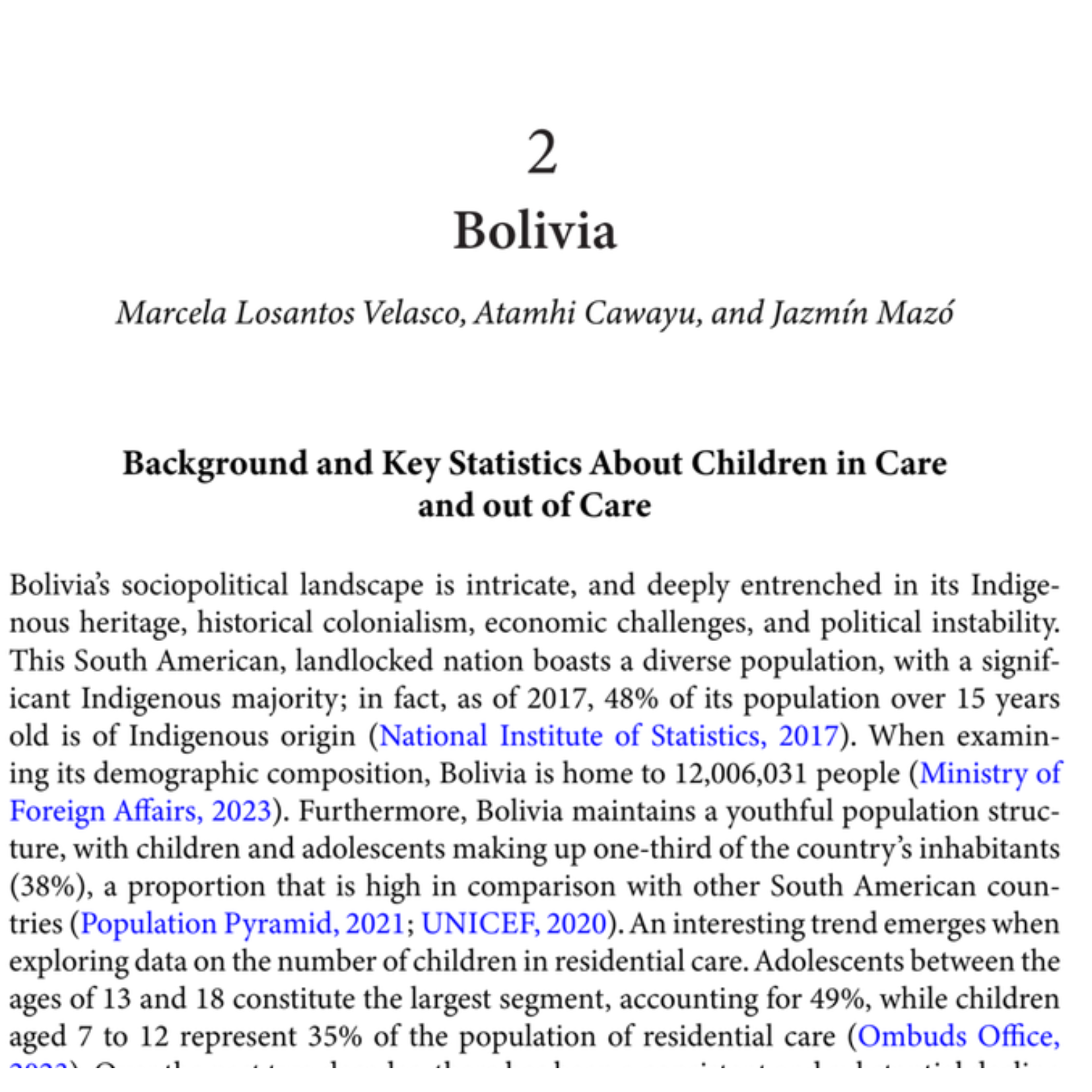
Bolivia's sociopolitical landscape is intricate, and deeply entrenched in its Indigenous heritage, historical colonialism, economic challenges, and political instability. This South American, landlocked nation boasts a diverse population, with a significant Indigenous majority; in fact, as of 2017, 48% of its population over 15 years old is of Indigenous origin (National Institute of Statistics, 2017). When examin-ing its demographic composition, Bolivia is home to 12,006,031 people (Ministry of Foreign Affairs, 2023). Furthermore, Bolivia maintains a youthful population struc-ture, with children and adolescents making up one-third of the country's inhabitants (38%), a proportion that is high in comparison with other South American countries (Population Pyramid, 2021; UNICEF, 2020). An interesting trend emerges when exploring data on the number of children in residential care. Adolescents between the ages of 13 and 18 constitute the largest segment, accounting for 49%, while children aged 7 to 12 represent 35% of the population of residential care (Ombuds Office, 2023). Over the past two decades, there has been a consistent and substantial decline in the overall number of children and adolescents in residential care, dropping from 19,118 in 2008 to 5,345 in 2021 (Ministry of Justice and Institutional Transparency & UNICEF, 2021). Notably, there was a significant decline in 2009, potentially indicating changes in data collection methods or pauses in data gathering. Subsequent decreases in the years following are primarily attributed to shifts in child welfare poli-cies, legislative alterations, and an emphasis on ensuring children's right to grow up within …